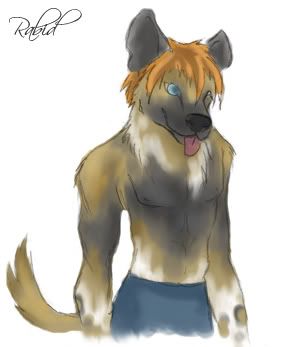
What serum do you want?: African Wild Dog
Describe your ideal 100% appearance: -
Link- Retaining only his messy orange hair (of course by then blotched a bit with the fur-patterns) he would be completely covered in fur, and have a fully-formed AWD head. Not even his eyes would remain humanoid. His body shape, while perhaps a tad hunched over, would remain basically the same except for the obvious changes, like claws/nails, fur (thicker on his joints), tail, and his ankles. Ankles and feet would be elongated into canine hind paws.
Why this animal/plant for your character?: The reason I want it for him is because it fits pretty well with his personality; enthusiastic, affectionate, altruistic, etc. However, because it's such a social animal, he'll be forced to stop being such a darn recluse! The reason it would be chosen for him by the good doctor, however, is merely for the sake of cruel irony. He was the one that supplied the DNA for that serum, and so it'll be a constant reminder to him that he played a part in this wicked experiment.
What do you think really makes this concept? As a Behavioural Ecologist, Brian will find himself wanting to 'make observations' about all the islanders he meets- his natural response will be to document the changes in a scientific fashion. But then he'll be struck with the realisation that that's as bad as continuing to work for the labs, and that he's a terrible person for treating this other human beings like subjects or wild animals. Of course, it'll be a waging battle between his own morals and his scientific curiosity, not to mention the overwhelming guilt of having been a hand in the transformation of these people. He'll have to decide if he's going to tell these other people the truth, or, fearing rejection, lie to protect himself. Lots of angst, and it's unique in that he was working for Feral Labs but had no idea what exactly he was contributing to. He'll be wanting to take notes, but at the same time hating himself for doing so!
General Information: Once numbering in the hundreds of thousands, the African wild dog (Lycaon pictus) is now one of the African continent's most endangered animals. It is believed that fewer than 5,000 wild dogs currently exist in the wild, and their range has declined from 33 to 15 countries. The largest populations exist in Botswana, Zimbabwe and Tanzania. The initial population reduction came during the early part of the century as a result of a very successful extermination campaign led by ranchers who feared the loss of livestock. Today, the effects of diseases (e.g., rabies, canine distemper, and parvovirus) spread by domestic dogs are having an even more devastating effect on wild dog numbers. Of additional concern is inbreeding due to the formation of genetically distinct groups of dogs in the southern and eastern regions of their current range.
Wild dogs are about the size of a German shepherd, have long legs, large ears and mottled fur of browns, black and white. They live in tightly bonded social groups or packs of 2 to 30 individuals led by a dominant male and female. Pack members exhibit well-defined greeting behaviors, the most obvious being affectionate face licking.
Recent research has shown the wild dog to have behaviors verging on classic altruism. This is particularly evident in pup raising, which is a pack effort with males shouldering much of the responsibility. In fact in one instance, following the death of a pack female, male pack members were observed successfully raising her pups from the age of five weeks.
Perhaps the most obvious expression of the wild dogs' altruistic tendencies is their feeding style. After a prey animal has been successfully brought down, each pack member is allowed to eat. The feeding scene is a peaceful one rather than a savage frenzy. Disabled pack members share alongside more able adults, and pups receive regurgitated food from any adult in the pack. This behavior is uncharacteristic of other large carnivores, such as lions, which often fight over a carcass, jostling with each other for access to food.
The behaviors that maintain close social bonds between pack members are a large factor in the decline of wild dogs; the close contact and associated licking promotes the spread of introduced diseases. Research efforts aim to gain information such as identification of social, ecological and demographic factors that affect pack reproductive success, breeding populations and population viability. Of additional interest is why wild dogs utilize such large territories and the interaction between wild dogs and other large predators.
Two of the projects currently under way in Africa to conserve and increase the number of wild dogs are supported in part by the One With Nature conservation program at the Philadelphia Zoological Garden, one of only 18 zoos in North America that maintains this species. The Botswana Wild Dog Research Project, in the Moremi Wildlife Reserve, is headed by Dr. J. Weldon McNutt. Kim McCreery and Dr. Robert Robbins lead research focused on the population of dogs in Hwange National Park, Zimbabwe. The projects are located in two very different ecosystems and are using technology such as global positioning systems and DNA analysis to track and learn more about wild dog biology and behavior. Information gained through research will be valuable in the development of conservation strategies for this species.
African wild dogs live in tightly knit social groups and hunt cooperatively, preying primarily on grazing animals such as gazelles, springboks, wildebeest and zebras. Most predators stalk or ambush their prey, but these animals make no attempt to hide. They simply approach a herd until it stampedes, then single out an individual -- usually one that's slowed by old age or disease -- and chase it until it's exhausted. The dogs are swift, tireless runners. They've been known to chase prey for an hour, for as far as three and a half miles (5.6 km).
Information stolen from here.