Mixolydia
(?)Community Member

Offline
- Posted: Mon, 09 Apr 2007 20:46:16 +0000
IMPORTANT LINKS FOR YOU
Special thanks to Jaaten Syric and Myxine Damion for supplying me with the additional sources.
And now for actual content. READ THIS PLZKTHX.
After seeing so many interesting topics float through ED with regards to one of my favourite topics, I thought I'd create my own, with a specific purpose in mind; completely obliterating any misconceptions about the topic of Evolution.
I'll begin with the ones I've seen far too much.
Darwin's theory of Evolution states that all species of animals adapt and evolve in their respective environments in order to survive. His concept of 'Survival of the Fittest' had nothing to do with which animal was the strongest, or the fastest. it has everything to do with genetic traits that will enable a species to survive the climate and predation of its environment. Case in point, the Peppered Moth.
Industrial melanism in peppered moths is one of the most frequently used examples of natural selection in action. This is largely because of its pedagogical simplicity -- it is a straightforward example that is visual and dynamic -- and its copious documentation. Industrial melanism refers to the darkening of color that occurred in a number of species of insects following the Industrial Revolution. This change appears to be related to the increase in pollutants in the environment. Before the Industrial Revolution, individuals of the moth species Biston betularia (commonly called the "peppered moth" wink were predominantly white with black speckles. By the end of the 1800s, they were predominantly charcoal grey. This change was well documented and led Tutt (1896) to hypothesize that this change was a result of pollution- stained trees' affecting the camouflage potential of the moths. This change was termed "industrial melanism." In the 1950s, Bernard Kettlewell decided to test the hypothesis that natural selection was working on the differential camouflage of the moths. In order to do this, he released marked light and dark moths into polluted and non-polluted forests. He found that birds appear to prey selectively on light moths in polluted forests and on dark moths in non-polluted forests and so documented the idea of natural selection of these color patterns in moths by birds. After anti-pollution laws took effect and the bark lightened, the moth populations in formerly polluted areas returned to previous color distributions.Source
The change in majority of darker or lighter peppered moths had everything to do with the fact that during the Industrial Revolution, the bark on the trees would be covered in soot from smoke and burning charcoal. This posed a horrible disadvantage to the lighter moths, because predators could now see them. The reverse happened when the environment cleared up and the tree barks were 'restored' to their original light colouration.
No. Those theories were never explored by Darwin at any point in his life. The theory that most people seem to connect with this is abiogenesis (life from non-life) and the observations made by Urey and Miller.
Source
Urey and Miller's experiments occurred after Darwin's time of proposing the theory of evolution. (And yes, someone made a crack at this idea using a jar of peanut butter under the idea that it was Evolution.)
For more on origin of earth/life, see the Big Bang Thread.
Not exactly. Yes, it was proposed that humans and the other Great Apes were (and still are) very closely related genetically. However, the process of Evolution was NEVER proposed as linear, in the sense that it was chimp > upright chimp > hairy neanderthal > human. That idea was originally proposed by the media during Darwin's life as an appeal to the public's ignorance attempting to make Darwin look bad. The issue: Darwin's ideas went against the church, because if humans evolved from apes, then they weren't divinely created by God.
In actuality, Darwin proposed the idea of a phylogenetic tree, which outlined a species' relation (genetically) to another using branches. The closer the branch, the closer you're related.
Source
Two basic examples of phylogenetic trees:

Source
This argument amuses me. Mostly because it's brought up countless times, despite the Evo-Regulars' numerous efforts otherwise. Anyway, this is taken from page 12.
If I come across or remember any more, I will include them.
This can be found on page 6 as well as (accidentally) quoted on page 9.
Quote:
An Essay on Evolution's compatibility with Creationism (also on page 9 of this thread.)
Evidence for Evolution
Wiki on Speciation
Evo Wiki: Observed Speciation
Macroevolution: Definition, Philosophy, & History
Hominid Evolution
Transitional Vertebrate Forms
Abiogenesis FAQ
More on Abiogenesis
Standing in the Scientific Community
Common Descent
Speciation
FAQ - Speciation
Evidence for Evolution
Wiki on Speciation
Evo Wiki: Observed Speciation
Macroevolution: Definition, Philosophy, & History
Hominid Evolution
Transitional Vertebrate Forms
Abiogenesis FAQ
More on Abiogenesis
Standing in the Scientific Community
Common Descent
Speciation
FAQ - Speciation
And now for actual content. READ THIS PLZKTHX.
***
After seeing so many interesting topics float through ED with regards to one of my favourite topics, I thought I'd create my own, with a specific purpose in mind; completely obliterating any misconceptions about the topic of Evolution.
I'll begin with the ones I've seen far too much.
I - Evolution is *insert some bad explanation for it here*
Darwin's theory of Evolution states that all species of animals adapt and evolve in their respective environments in order to survive. His concept of 'Survival of the Fittest' had nothing to do with which animal was the strongest, or the fastest. it has everything to do with genetic traits that will enable a species to survive the climate and predation of its environment. Case in point, the Peppered Moth.
The Story of the Peppered Moth
Industrial melanism in peppered moths is one of the most frequently used examples of natural selection in action. This is largely because of its pedagogical simplicity -- it is a straightforward example that is visual and dynamic -- and its copious documentation. Industrial melanism refers to the darkening of color that occurred in a number of species of insects following the Industrial Revolution. This change appears to be related to the increase in pollutants in the environment. Before the Industrial Revolution, individuals of the moth species Biston betularia (commonly called the "peppered moth" wink were predominantly white with black speckles. By the end of the 1800s, they were predominantly charcoal grey. This change was well documented and led Tutt (1896) to hypothesize that this change was a result of pollution- stained trees' affecting the camouflage potential of the moths. This change was termed "industrial melanism." In the 1950s, Bernard Kettlewell decided to test the hypothesis that natural selection was working on the differential camouflage of the moths. In order to do this, he released marked light and dark moths into polluted and non-polluted forests. He found that birds appear to prey selectively on light moths in polluted forests and on dark moths in non-polluted forests and so documented the idea of natural selection of these color patterns in moths by birds. After anti-pollution laws took effect and the bark lightened, the moth populations in formerly polluted areas returned to previous color distributions.
The change in majority of darker or lighter peppered moths had everything to do with the fact that during the Industrial Revolution, the bark on the trees would be covered in soot from smoke and burning charcoal. This posed a horrible disadvantage to the lighter moths, because predators could now see them. The reverse happened when the environment cleared up and the tree barks were 'restored' to their original light colouration.
II - Evolution tells us where life came from
No. Those theories were never explored by Darwin at any point in his life. The theory that most people seem to connect with this is abiogenesis (life from non-life) and the observations made by Urey and Miller.
Miller/Urey Experiment
By the 1950s, scientists were in hot pursuit of the origin of life. Around the world, the scientific community was examining what kind of environment would be needed to allow life to begin. In 1953, Stanley L. Miller and Harold C. Urey, working at the University of Chicago, conducted an experiment which would change the approach of scientific investigation into the origin of life.
Miller took molecules which were believed to represent the major components of the early Earth's atmosphere and put them into a closed system.
The gases they used were methane (CH4), ammonia (NH3), hydrogen (H2), and water (H2O). Next, he ran a continuous electric current through the system, to simulate lightning storms believed to be common on the early earth. Analysis of the experiment was done by chromotography. At the end of one week, Miller observed that as much as 10-15% of the carbon was now in the form of organic compounds. Two percent of the carbon had formed some of the amino acids which are used to make proteins. Perhaps most importantly, Miller's experiment showed that organic compounds such as amino acids, which are essential to cellular life, could be made easily under the conditions that scientists believed to be present on the early earth. This enormous finding inspired a multitude of further experiments.
Miller took molecules which were believed to represent the major components of the early Earth's atmosphere and put them into a closed system.
The gases they used were methane (CH4), ammonia (NH3), hydrogen (H2), and water (H2O). Next, he ran a continuous electric current through the system, to simulate lightning storms believed to be common on the early earth. Analysis of the experiment was done by chromotography. At the end of one week, Miller observed that as much as 10-15% of the carbon was now in the form of organic compounds. Two percent of the carbon had formed some of the amino acids which are used to make proteins. Perhaps most importantly, Miller's experiment showed that organic compounds such as amino acids, which are essential to cellular life, could be made easily under the conditions that scientists believed to be present on the early earth. This enormous finding inspired a multitude of further experiments.
Urey and Miller's experiments occurred after Darwin's time of proposing the theory of evolution. (And yes, someone made a crack at this idea using a jar of peanut butter under the idea that it was Evolution.)
For more on origin of earth/life, see the Big Bang Thread.
III - We all evolved from monkeys, so why are there still chimpanzees?
Not exactly. Yes, it was proposed that humans and the other Great Apes were (and still are) very closely related genetically. However, the process of Evolution was NEVER proposed as linear, in the sense that it was chimp > upright chimp > hairy neanderthal > human. That idea was originally proposed by the media during Darwin's life as an appeal to the public's ignorance attempting to make Darwin look bad. The issue: Darwin's ideas went against the church, because if humans evolved from apes, then they weren't divinely created by God.
In actuality, Darwin proposed the idea of a phylogenetic tree, which outlined a species' relation (genetically) to another using branches. The closer the branch, the closer you're related.
Darwin's Tree of Life
In biology, a phylogenetic tree, or phylogeny, is used to show the genealogic relationships of living things. A phylogeny is not so much evidence for evolution as much as it is a codification of data about evolutionary history. According to biological evolution, organisms share common ancestors; a phylogeny shows how organisms are related. The tree of life shows the path evolution took to get to the current diversity of life. It also shows that we can ascertain the genealogy of disparate living organisms. This is evidence for evolution only in that we can construct such trees at all. If evolution did not happen or common ancestry is false, we would not be able to discover hierarchical branching genealogies for organisms (although textbooks do not generally explain this well). Referring to any phylogenetic tree as "Darwin's tree of life" is somewhat of a misnomer. Darwin graphically presented no phylogenies in the Origin of Species; the only figure there depicts differential rates of speciation. If anyone deserves credit for giving us "trees of life," it is Ernst Haeckel, who drew phylogenies for many of the living groups of animals literally as trees, as well as coining the term itself.
Two basic examples of phylogenetic trees:
Darwin's Finches
"Darwin's finches," along with Hawaiian honeycreepers and African cichlids, are frequently used as examples of adaptive radiation. In an adaptive radiation, a "founder" species enters a new environment with many unoccupied niches. This species expands (radiates) and evolves adaptations to fit these niches better. The process of becoming adapted to these different niches may lead to, and in these cases has led to, the formation of new species. All the species of finches on the Galápagos Islands appear morphologically very similar, varying mostly in terms of beak size and behavior; they all look very much like a species of finch from the mainland of South America. This suggests that all the finches on the Galápagos are descended from one original colonist species that went through an adaptive radiation. Because of the small, isolated environment of the Galápagos, the finches have become the topic of extensive study into natural selection. The studies that have been conducted on the finches show strong selection for larger beaks during droughts. These data show that climatic changes can have profound effects on the morphology of a species and potentially lead to the formation of new species. When Darwin visited the Galápagos, he observed and collected some of the finch species, believing that they represented a very diverse set of birds that were not closely related. Their significance was not recognized until later, when ornithologist John Gould pointed out that the birds were all closely related finches (Desmond and Moore 1991). But because Darwin originally collected some of the specimens and because the finches showed so much evidence for evolution and natural selection, they have been dubbed "Darwin's finches." This has led many people to conclude (mistakenly) that Darwin's theory of evolution was specifically inspired by the finches.
IV - Evolution has no evidence to back it up.
This argument amuses me. Mostly because it's brought up countless times, despite the Evo-Regulars' numerous efforts otherwise. Anyway, this is taken from page 12.
Poindextra
OHAYPPL.
So people have been posting around ED (and NOT in this thread, how disappoining) about how there's no solid backing for Evolution.
Allow me to make these statements clear first;
And now, for the pertinent point behind this post; slides from a PowerPoint Presentation created by my Biology Professor, Dr. Alex Mills.
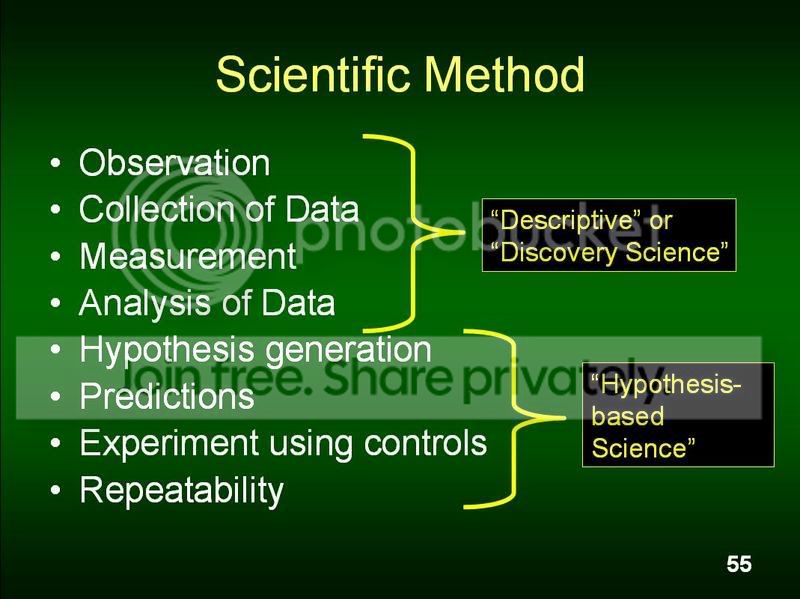
In this first one, it outlines two different scientific methods.
The first one is what happened with Darwin during the journey of the HMS Beagle, the observations of which are published in his Origin of Species.
The second is a more commonly known method, which is most likely what's used to study and support Evolution today.
Also note the word Repeatability. If an experiment cannot be repeated, or similar observations cannot be repeated, the original hypothesis/discovery is rejected as a theory.
And the second slide, separating the meaning of Theory and Hypothesis in the scientific sense. Note the underlined point.
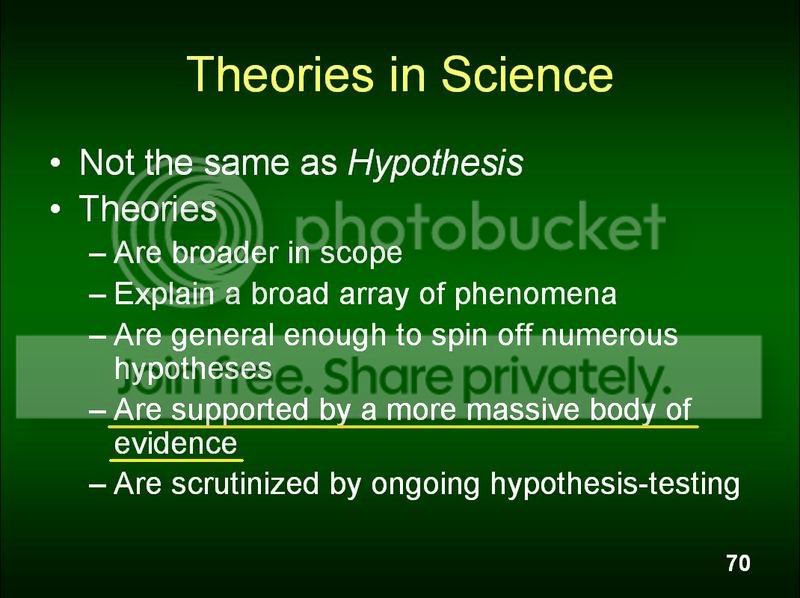
Being that Evolution is a scientific theory, it can be automatically assumed (and known) that there is a massive amount of evidence to back it up.
That's all for now, kids! heart
(slides used with permission from Dr. Alex Mills, Biology Professor at the University of Windsor.)
Also, for more on the Scientific Method and subsequent testing, go HERE.
So people have been posting around ED (and NOT in this thread, how disappoining) about how there's no solid backing for Evolution.
Allow me to make these statements clear first;
- *Evolution is considered a scientific explanation of adaptation.
*Science involves rigorous testing of materials/hypotheses in order to be proven true.
And now, for the pertinent point behind this post; slides from a PowerPoint Presentation created by my Biology Professor, Dr. Alex Mills.
In this first one, it outlines two different scientific methods.
The first one is what happened with Darwin during the journey of the HMS Beagle, the observations of which are published in his Origin of Species.
The second is a more commonly known method, which is most likely what's used to study and support Evolution today.
Also note the word Repeatability. If an experiment cannot be repeated, or similar observations cannot be repeated, the original hypothesis/discovery is rejected as a theory.
And the second slide, separating the meaning of Theory and Hypothesis in the scientific sense. Note the underlined point.
Being that Evolution is a scientific theory, it can be automatically assumed (and known) that there is a massive amount of evidence to back it up.
That's all for now, kids! heart
(slides used with permission from Dr. Alex Mills, Biology Professor at the University of Windsor.)
Also, for more on the Scientific Method and subsequent testing, go HERE.
If I come across or remember any more, I will include them.
***
ON GOD VS EVOLUTION
This can be found on page 6 as well as (accidentally) quoted on page 9.
Poindextra
While perusing a very interesting magazine I'm reading for my history paper, I came across a lovely article entitled 'Jews for Darwin.' And lo and behold....It took the words right out of my mouth (minus the Jewish part.) Here I will highlight relevant points.
Basically he's saying that anyone who believes in Genesis (specifically Orthodox Jews, but the concept works for all Genesis believers) is perfectly alright in doing so.
[Source taken from Skeptic Magazine, Vol. 13, No.1 - 2007.]
Jews for Darwin
The relevant text is (Genesis 1:25): "God made (Hebrew, vaya'as') the wild animals...and the cattle...and animals that crawl." Genesis does not say: "God created (vayivra the wild animals...etc." The verbs make and create denote two quite different processes. If one says that he has made a chair, no one would think that he meant creation ex nihilo. The verb "make" means to fashion something complex out of something simple, which is quite compatible with the scientific concept of evolution, whereby the modern panorama of complex animal life developed from simpler earlier creatures. Whether or not these evolutionary processes were orchestrated by God is a matter of religious belief.
Basically he's saying that anyone who believes in Genesis (specifically Orthodox Jews, but the concept works for all Genesis believers) is perfectly alright in doing so.
[Source taken from Skeptic Magazine, Vol. 13, No.1 - 2007.]